


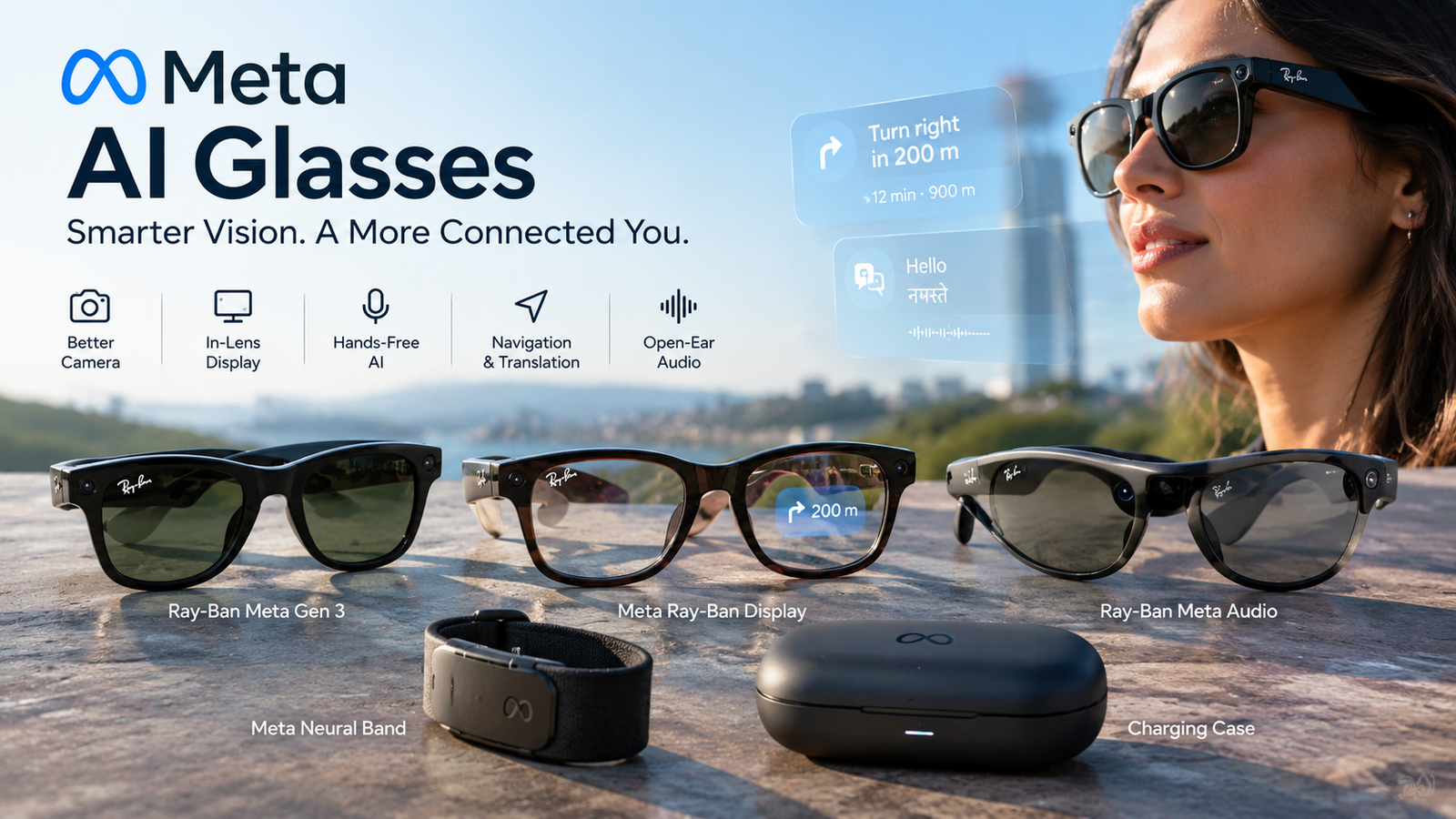
Meta is expanding its AI glasses lineup with new hands-free features, updated display capabilities, improved cameras, longer battery life and a new audio-focused model. The company announced the latest developments during Meta Connect 2026.
Meta’s latest announcements cover several parts of its glasses ecosystem, including Ray-Ban Meta Gen 3, Ray-Ban Meta Audio, Meta Ray-Ban Display and Meta Glasses. The company says its lineup will grow to more than 100 AI-glasses options across Ray-Ban, Oakley and Meta Glasses by the end of 2026. More technology updates are available in Chavaiz’s Technology section.
Meta Updates Ray-Ban Display With New Hands-Free Features
Meta Ray-Ban Display is not a newly introduced product. At Connect 2026, Meta announced additional features designed to make the existing display-equipped glasses more useful.
One of the major updates is hands-free navigation. Users can ask for cycling or public-transit directions by voice, while turn-by-turn information and real-time transit departures can appear on the glasses’ display. Meta is also introducing walking directions that can use recognizable surroundings, such as a particular house, instead of relying only on street names.
Meta is also adding a personalized hologram feature for video calls. After a short capture through the Meta AI app, users can create a digital version of their face that can appear during calls. The hologram is driven by the user’s voice and can reproduce expressions based on speech.
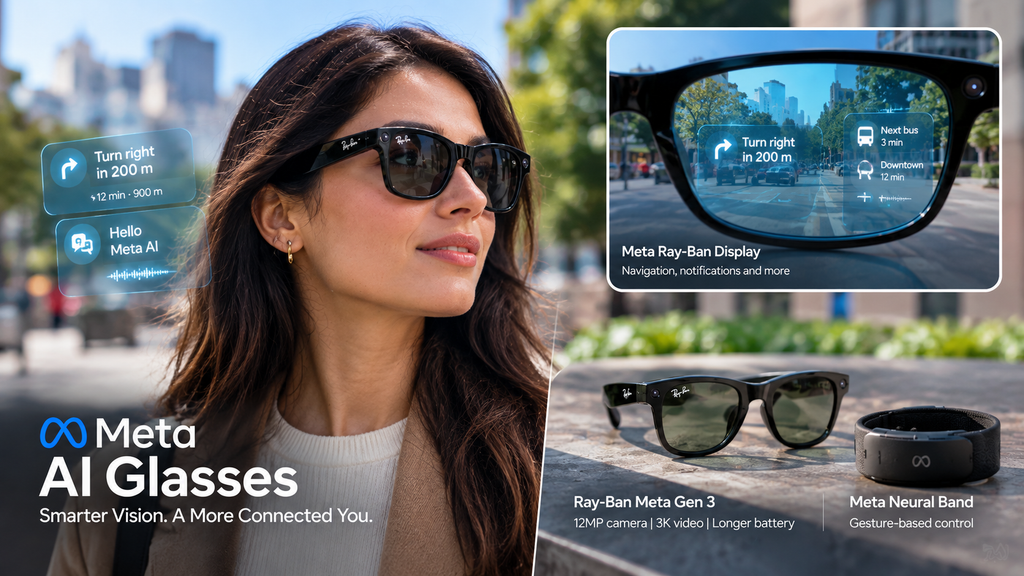
Other updates include the new Explore experience, mirrored phone notifications, calendar functions and Dolby Atmos video capture with spatial surround sound.
Ray-Ban Meta Gen 3 Gets a 12MP Camera and 3K Video
Meta has also introduced Ray-Ban Meta Gen 3, the next generation of its AI glasses.
The new model features a slimmer design, longer battery life and a customizable action button for quicker access to Meta AI. Meta says Gen 3 can provide up to nine hours of battery life, while its six-microphone system is designed to reduce more than 90% of background noise.
For photography and video, Gen 3 includes a 12-megapixel camera with 3K Ultra HD video recording. Users can capture photos and videos hands-free, while a new dynamic-photo feature allows users to select the best frame from captured moments.
Meta also says AI glasses will later become the first consumer devices capable of capturing and experiencing video in Dolby Atmos with 360-degree spatial sound.
Ray-Ban Meta Audio Brings AI and Open-Ear Sound
Meta has also introduced Ray-Ban Meta Audio, its first dedicated audio glasses.
The glasses are designed to combine the functions of earbuds and AI assistance in a glasses form factor. Users can listen to music and podcasts, take calls and interact with an AI assistant hands-free while remaining aware of sounds around them.
The glasses weigh about 43 grams and provide up to 12 hours of use on a single charge. The included charging case can provide up to an additional 48 hours of battery capacity.
Muse Is Coming to Meta AI Glasses
Another major development is the integration of Muse, Meta’s personal AI agent, with its AI glasses.
Meta says Muse will allow users to interact with their personal AI agent through the glasses and have it act on what they are looking at. For example, users could ask about a product on a shelf, information on a flyer or a list of items without first describing everything manually.
The company says Muse will also gain additional connectors and capabilities designed to help with shopping, travel, work and everyday tasks.
Meta Plans More Than 100 AI Glasses Options
Meta is also expanding the number of designs available across its wearable ecosystem.
By the end of 2026, Meta says it expects to offer more than 100 different AI-glasses options across Ray-Ban, Oakley and Meta Glasses. The expansion includes different frame designs, colors, lenses and configurations, rather than representing 100 completely different technology platforms.
The company is therefore combining its existing AI-glasses technology with new hardware designs and software updates instead of relying on a single glasses model.
AI Glasses Are Moving Beyond Cameras
Meta’s latest announcements show how its AI-glasses strategy is developing across several areas.
The technology now combines AI assistance, cameras, open-ear audio, displays, navigation, hands-free controls and new software experiences. Some capabilities, such as the Neural Band and Meta Ray-Ban Display, were introduced previously and are now receiving additional features rather than being completely new technologies at Connect 2026.
With Gen 3, Meta is also improving the underlying hardware through a 12MP camera, 3K video, longer battery life and better microphones. Meanwhile, Ray-Ban Meta Audio provides an option focused primarily on audio and AI without an in-lens display.
Source: Meta Newsroom — announcements published September 23–24, 2026.